Your numbers are always describing a month you can no longer change.
By the time productivity reaches you it is retrospective, aggregated by somebody with their own method, and too late to act on. The unit that quietly ran twelve percent over on overtime for six weeks shows up as a variance in a meeting, long after the two people it burned out have already given notice.
- Every manager builds their staffing spreadsheet a slightly different way, so nothing is genuinely comparable.
- Productivity numbers arrive days late — you manage the past, not the shift.
- Overtime concentrates on the same handful of names for months before anyone sees the pattern.
- Turnover shows up as a resignation, never as a trend you could have interrupted.
- Preparing for a board meeting means a week of someone else's spreadsheet work.
- Practice varies unit to unit because there is no standard workflow to vary from.
What the week looks like instead.
Same accountability, same units — a shorter distance between something happening and you knowing about it.
- MondayYou see every unit the same way.
Productivity index against target, worked hours per patient day, demand versus effort, and coverage by role — computed identically everywhere, so a comparison is actually a comparison.
- TuesdayOvertime concentration flags itself.
Not total overtime — whose. When the same four names carry a unit's extra hours for six straight weeks, that is a resignation forming, and it is visible while it is still reversible.
- WednesdayYou ask a question instead of requesting a report.
Beam answers in plain language from governed metrics — "why did PI% drop on nights last period?" — and produces the chart and the action plan with it.
- ThursdayPolicy gets drafted in an afternoon, not a quarter.
Keeper drafts evidence-informed policy with formal citations to CDC, TJC, CMS, INS and AACN. A human still reviews and signs — but from a draft, not a blank page.
- FridayThe board pack builds itself.
Any chart exports board-ready to PDF or Excel. Tenure, headcount, hires versus separations, 90-day retention and first-year turnover computed live from the roster.
Not mockups. This is what you’d be looking at.
One command center, every unit
Productivity index, HPPD, the full hours story and coverage — drillable by role, shift, person, day or pay period, and identical in every unit you're accountable for.
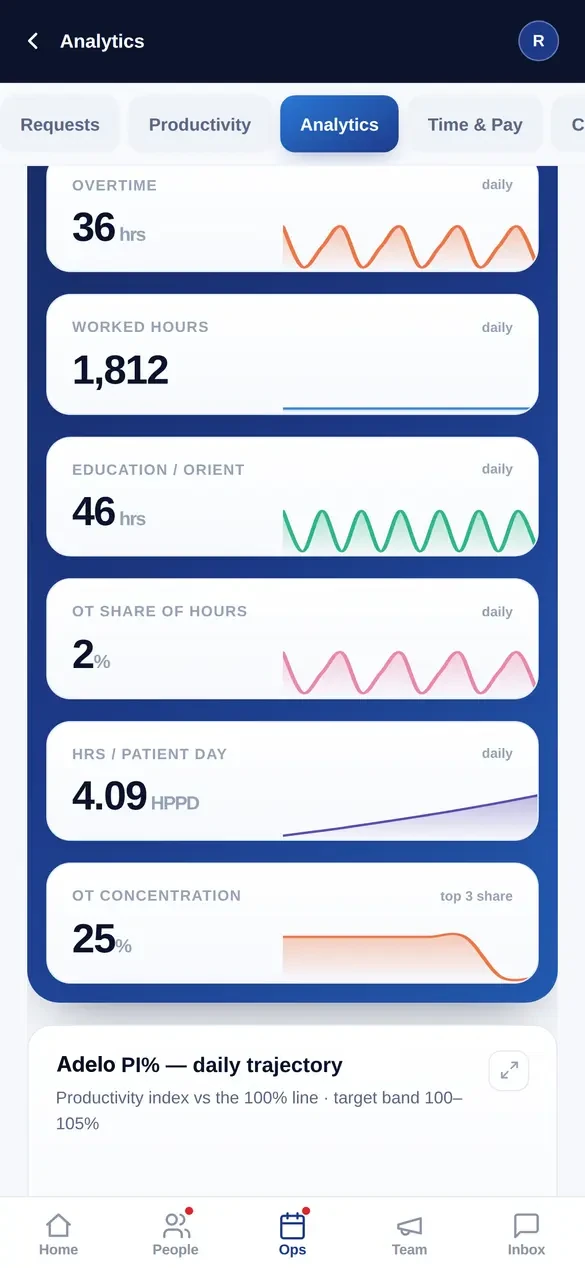
The executive view
Tenure distribution, headcount, hires versus separations by month or quarter, 90-day retention and first-year turnover — computed live, not reconstructed quarterly.
Captured from a demonstration unit with fictional staff and data.
One point of turnover, across the units you own
Retention is the outcome your instrumentation is ultimately for. These are industry figures — the point is the order of magnitude, not the decimal.
Industry figures — not Adelo results. Source: 2026 NSI National Health Care Retention & RN Staffing Report.
What you get, and where it sits.
Unit-level capability is Premium. Cross-unit rollup and centralized administration are Enterprise.
Staffing intelligence
- Productivity index (PI%) against target, livePremium
- Worked hours per patient day and demand vs censusPremium
- Coverage heatmaps by role and shiftPremium
- Burnout watch — overtime concentration by personPremium
- Drill-downs saved, pinned and arranged per userPremium
- Workforce visibility across every unitEnterprise
Retention & workforce
- Tenure distribution and headcountPremium
- Hires vs separations by month, quarter or yearPremium
- 90-day retention and first-year turnover (NSI method)Premium
- Recognition, Pulse Points and Pulse ChecksPremium
- Transparent attendance standing across unitsPremium
- Organization-wide rollup and administrationEnterprise
Governance & reporting
- Beam — plain-language analytics from governed metricsPremium
- Keeper — cited, survey-ready policy draftingPremium
- Rounding and bundle audits, corrective actionsPremium
- 30-day compliance scorePremium
- Board-ready PDF and Excel export from any chartPremium
- Standardized, repeatable workflows across unitsPremium
It sits beside your system of record, not on top of it.
Adelo does not replace your HCM, your payroll, or your system of record, and it does not need to touch them to be useful. Your HCM knows who works here; Adelo knows how the unit is running. Integrations with HR systems and identity providers are on the roadmap and not implemented today — Enterprise includes integration planning and data-import support now.
- No replacement of, or write-back to, your system of record
- Unit-level data isolation with role-based, least-privilege access
- Patient information is out of scope by design
- Security documentation available on request