The rollup is only ever as good as the least consistent unit in it.
Enterprise workforce systems already know who works here. What they cannot tell you is how any given unit is actually running today, because the operating layer — the schedule, the coverage, the swaps, the chasing — lives in spreadsheets and text threads that never reach a system at all. So the numbers that arrive are late, differently calculated, and describe a month you can no longer influence.
- Every unit calculates its own version of the same metric, so consolidation is negotiation.
- The operating layer is invisible: the work of running a shift leaves no data behind.
- A large HCM implementation takes quarters and still does not reach the floor.
- Overtime and agency spend surface as variance long after the decisions that caused them.
- Practice varies unit to unit, and nobody can say by how much.
- Point tools proliferate below procurement's line of sight.
How this actually gets adopted.
Not a program. A unit, then another unit, then a service line — because there is nothing to install.
- Week 1One unit goes live without an IT project.
Roster, roles and schedule stood up; staff join with a shared code and their employee ID. It runs in any phone browser, so adoption happens in a break room rather than in a deployment plan.
- Week 2The free tier does the recruiting for you.
Every worker keeps Adelo free forever — their schedule, swaps, shift chat, credentials. Adoption is not something leadership has to enforce, which is the usual reason these rollouts stall.
- Month 2A second and third unit run identically.
Same workflows, same definitions, same instrumentation — which is the precondition for the comparison you actually want, not a consequence of it.
- Quarter 1The rollup starts meaning something.
Productivity, hours per patient day, overtime concentration and retention, computed the same way everywhere, available on the day rather than the month after.
- OngoingGovernance stops being a scramble.
Policy lifecycle, rounding audits, deficiency tracking and corrective actions run the same way in every unit — so survey preparation is a report, not a project.
Not mockups. This is what you’d be looking at.
The same command center everywhere
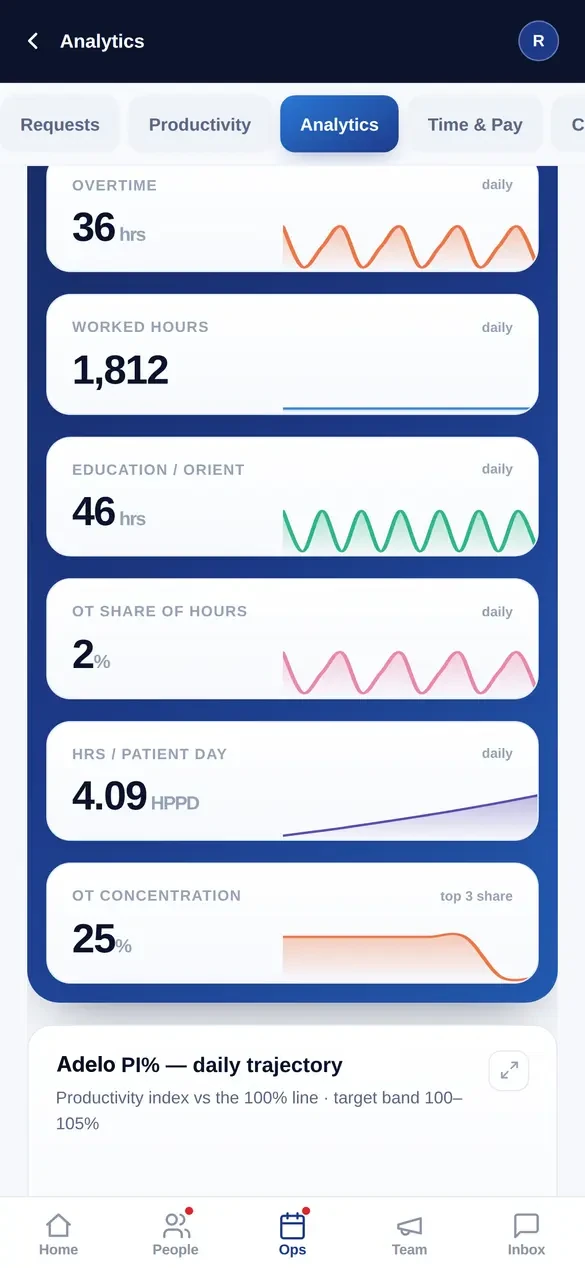
Productivity index, hours per patient day, coverage and burnout watch — identical definitions in every unit, which is what makes cross-unit comparison honest.
The workforce picture
Tenure, headcount, hires versus separations, 90-day retention and first-year turnover — computed live rather than assembled quarterly.
Captured from a demonstration unit with fictional staff and data.
Why workforce is the line worth instrumenting first
Industry figures, per hospital. Multiply by the number of facilities you're accountable for — that is the size of the thing currently being managed in spreadsheets.
Industry figures — not Adelo results. Source: 2026 NSI National Health Care Retention & RN Staffing Report.
What sits where.
Unit capability is Premium. Anything that spans units — rollup, central administration, implementation — is Enterprise.
Across the organization
- Workforce visibility across every unitEnterprise
- Centralized administrationEnterprise
- Implementation supportEnterprise
- Integration planning and data-import supportEnterprise
- Custom pricing across departments and facilitiesEnterprise
- Standardized, repeatable processesPremium
In every unit
- Live staffing analytics with PI% and HPPDPremium
- Executive HR analytics and retention metricsPremium
- Coverage, open shifts and approval workflowsPremium
- Transparent attendance standingPremium
- Beam and Keeper — analytics and policy AIPremium
- Quality audits and corrective actionsPremium
For every worker
- Today's shift, schedule and teamFree
- Shift swapsFree
- Unit channels and announcementsFree
- License, credential and CE trackingFree
- Peer and leader recognitionFree
- Free forever — never billed to the individualFree
What this does not ask of you.
No replacement of your HCM or system of record. No directory integration required to start. No on-premises component, no agent, and nothing to install on a device. Adelo is scoped to exclude patient information by design, which is a large part of why a unit can be live in days rather than quarters.
- Runs alongside your system of record, with no write-back
- Role-based, least-privilege access; units isolated from one another
- Not SOC 2 or HITRUST certified — we publish our posture honestly
- Security documentation available on request