Nobody hired you to be a dispatcher.
The job you were promoted into was leading a clinical team. The job you actually do most days is reconciling a spreadsheet against a text thread against a scheduling app, then chasing people individually until the holes close. It is the most replaceable part of your week and it eats the most of it.
- A gap opens on nights and you mass-text forty people, then wait, then call agency anyway.
- Swaps get agreed in a group chat and lost — until two people show up for the same shift, or neither does.
- You find out someone's pattern of call-outs is a pattern only after it becomes a conversation with HR.
- Somebody's license lapsed and nobody knew until the survey.
- Your productivity numbers arrive days later, in a spreadsheet somebody else built.
- You hear the good work happened. The person who did it never hears that you heard.
What Tuesday looks like instead.
Nothing here is a new habit. It is the same day with the chasing taken out of it.
- 06:40You open Adelo before you open the unit.
Today's lineup by role and shift, who called out, what needs you, and the two approvals waiting. One screen, on your phone, before you've parked.
- 09:15A gap opens on nights.
You post it once. It reaches the people who are actually eligible and actually want it — with their overtime exposure shown to you, so you can see who's heading for burnout before you approve them into it.
- 11:30Two swaps and a time-off request clear in four taps.
Each one already checked for eligibility. Each one documented, so the version of events is the same in six weeks as it is today.
- 14:00A director asks how the unit is running.
Productivity index against target, worked hours per patient day, and the overtime concentration — live, drillable, exportable to a board-ready PDF from your phone before the meeting starts.
- 19:52The gap you posted at 09:15 is filled.
You approved it from the car. Nobody was mass-texted. Agency was not called.
- 22:10You send one kudos that names the actual thing.
A specific save on a specific shift, seen by the whole unit. It costs you ninety seconds and it is the reason that nurse is still here next year.
Not mockups. This is what you’d be looking at.
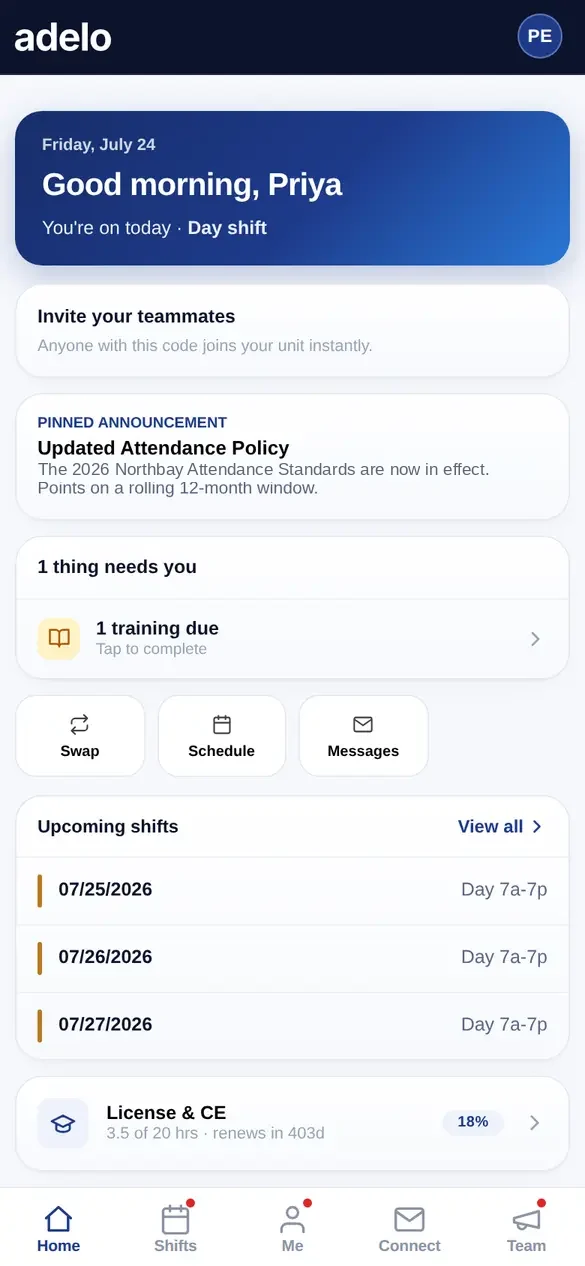
Coverage, live, by role and shift
The lineup you currently rebuild in your head every morning — already built, already current, and drillable down to the person.
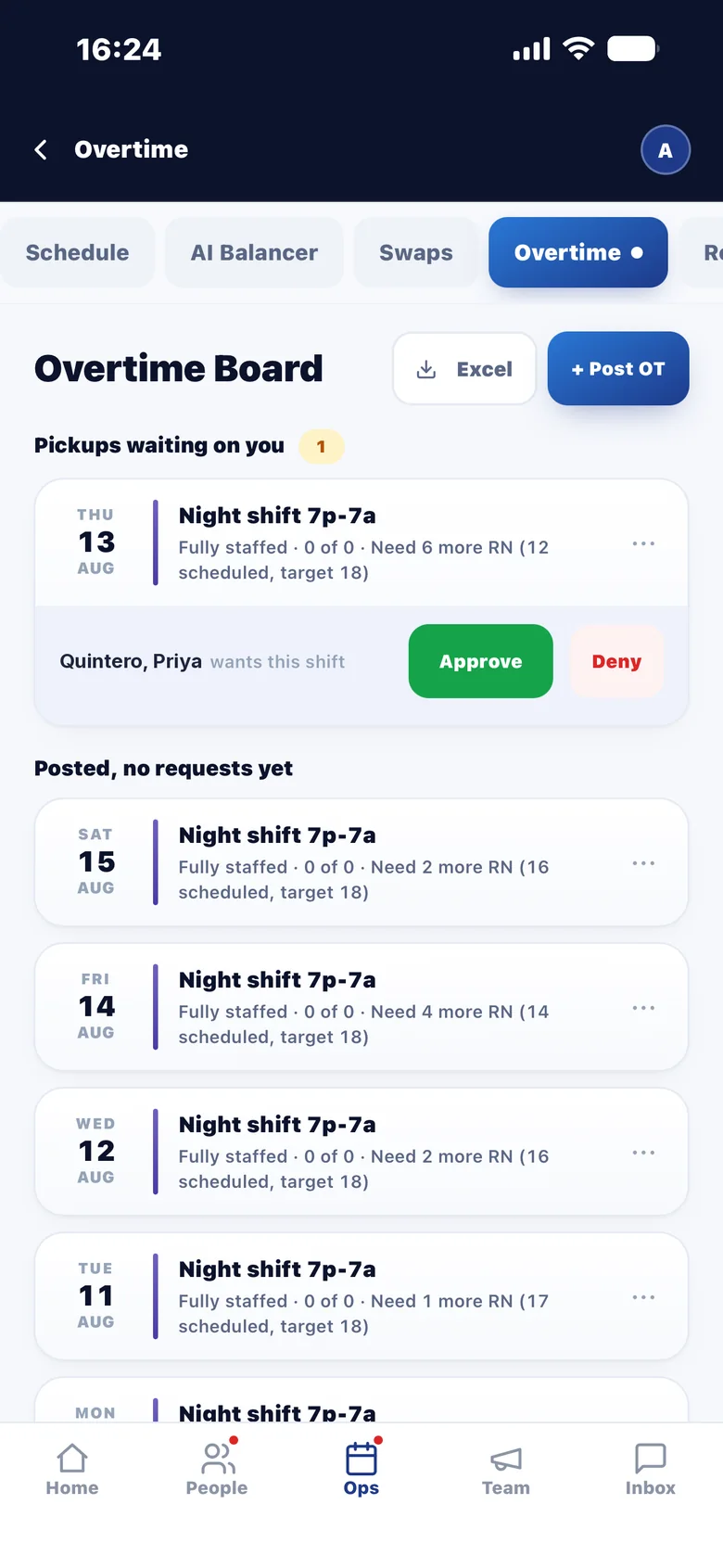
Post the gap once
Open shifts go to eligible staff with burnout-watch analytics beside each name, so you can see overtime concentration before you approve it — not after somebody resigns.
Attendance both of you can see
The same standing for leader and employee. Follow-up happens early and consistently, and nobody is ever surprised by a conversation they could have seen coming.
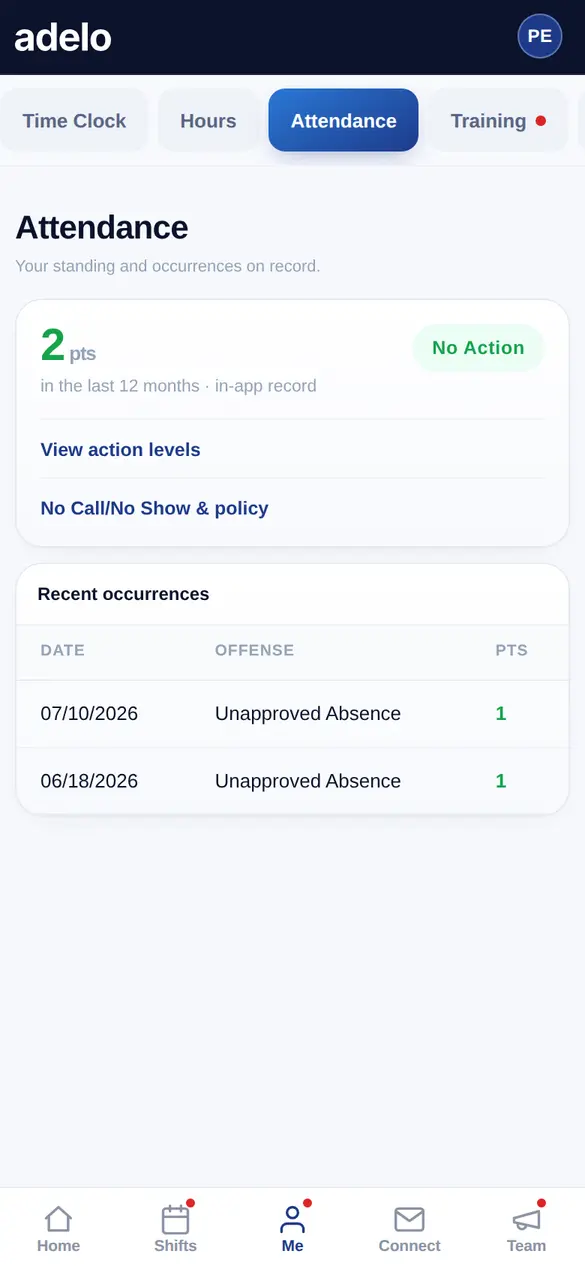
Captured from a demonstration unit with fictional staff and data.
The chasing is not free. It just isn’t invoiced.
Put your own unit’s numbers in. This sizes what turnover already costs you — it does not claim Adelo fixes it.
Keep one nurse who would otherwise have left, and it covers Adelo for 16.7 years. Everything else it does — the coverage, the analytics, the hours nobody spends chasing texts — is on top of that.
This sizes the cost of a problem — it is not a savings claim. Adelo is early and has published no retention results, so nothing here assumes it changes your turnover rate. Turnover and cost defaults come from the 2026 NSI National Health Care Retention & RN Staffing Report. Adelo pricing is $4.99/member/month billed annually, $149/month minimum.
Everything you'd use, and exactly what it costs.
Your staff never pay for anything. The lines marked Premium are the leadership layer, billed to the unit.
Coverage & scheduling
- Six-week published schedule your team can seePremium
- Open shifts and overtime pickupsPremium
- Burnout watch — overtime concentration by personPremium
- AI Balancer proposes a balanced schedulePremium
- Shift swaps, requested and trackedFree
- One-tap swap and time-off approvalsPremium
The day, and the people in it
- Unit channels, announcements and direct messagesFree
- Today's shift, team and priorities for every personFree
- Transparent attendance standing and escalationsPremium
- Time clock, geofencing and timesheetsPremium
- Forms and requests, standardizedPremium
- Kudos and recognition from peers and leadersFree
Knowing how the unit is running
- Productivity index and hours per patient day, livePremium
- Drill any chart by role, shift, person or pay periodPremium
- Board-ready PDF and Excel export from your phonePremium
- Beam — ask analytics questions in plain languagePremium
- License, credential and CE tracking with remindersFree
- Training command center with completion visibilityPremium
You won't need a project to start this.
There is nothing to install and no integration to schedule. We stand up your unit, roster and roles; your team joins with one shared code and their employee ID; you approve them with a tap. It runs in any phone browser, which means adoption happens in a break room rather than in a rollout plan.
- Live in days, not an IT project
- Role-based access — charge, manager, HR and executive each see only what their role needs
- Your unit's data is isolated from every other unit
- Patient information is out of scope by design and should never be entered